
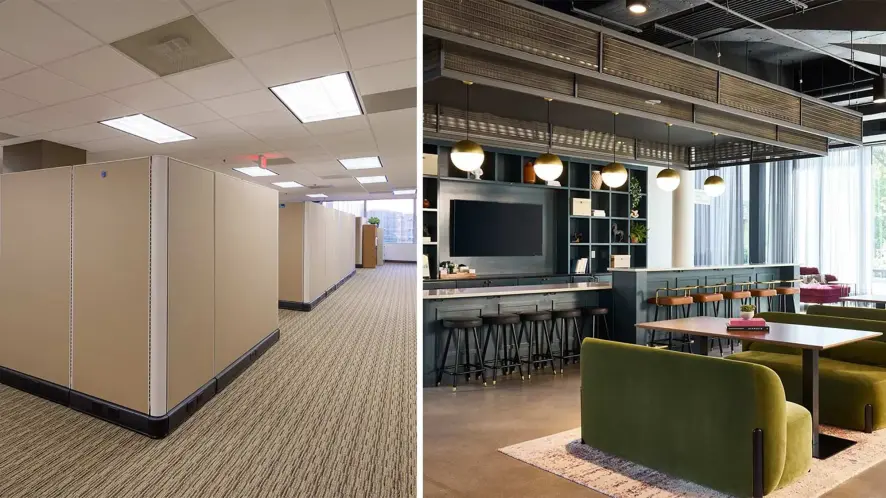
The urban landscape is facing a dual crisis. In major metropolitan areas across the United States, commercial business districts are struggling with historically high office vacancy rates. The widespread adoption of permanent hybrid and remote work models has fundamentally altered corporate real estate needs, leaving millions of square feet of office space dark and underutilized. Simultaneously, the nation is grappling with a severe shortage of affordable housing, driving up rents and placing homeownership out of reach for a vast segment of the population.
On the surface, the solution appears elegantly simple: convert vacant commercial office buildings into residential apartments. This concept, known as adaptive reuse, has captured the imagination of urban planners, policymakers, and real estate developers alike. It promises to revitalize stagnant downtown economies, preserve existing architectural structures, and rapidly inject much-needed housing stock into supply-constrained markets. However, translating this concept into reality involves navigating a complex maze of architectural, financial, and regulatory hurdles.
The Architectural and Engineering Realities of Conversion
The primary obstacle to commercial-to-residential conversions is not a lack of imagination, but rather the physics of the buildings themselves. Modern commercial office towers were designed around the needs of corporations, not households, creating significant structural misalignments.
The Deep Floor Plate Challenge
Commercial office buildings constructed over the last several decades typically feature massive, square floor plates designed to maximize interior cubicle space and conference rooms. Residential building codes, however, strictly dictate that every habitable room, particularly bedrooms, must have access to operable windows for natural light and emergency ventilation. When converting a deep office floor plate, developers are left with a massive core area that has zero access to exterior windows. Creative solutions include cutting large light wells or structural courtyards down through the center of the building, though this process is structurally complex and expensive.
Plumbing and Mechanical Overhauls
In a standard office building, plumbing infrastructure is highly centralized, consisting of a single core stack of restrooms and drinking fountains located near the central elevator bay on each floor. A residential apartment building requires decentralized plumbing, with independent water lines, drainage, and vent stacks routed to every single kitchen and bathroom in individual units. Retrofitting thousands of new pipes through existing post-tensioned concrete floor slabs requires extensive scanning and coring, which can jeopardize structural integrity if executed incorrectly.
HVAC and Environmental Systems
Office buildings generally utilize centralized heating, ventilation, and air conditioning systems that condition entire floors uniformly based on commercial hours of operation. Converting these spaces to residential living requires replacing these massive systems with individual, tenant-controlled HVAC units or complex variable refrigerant flow systems. Additionally, older commercial buildings often require extensive environmental remediation to safely remove asbestos, lead, or chemical sealants before they can be legally occupied by residents.
The Financial Math: When Does Adaptive Reuse Make Sense?
From an investment perspective, an office building will only be converted if the total cost of acquisition and renovation is lower than the cost of building a brand-new residential tower from the ground up.
-
The Acquisition Discount Requirement: For a conversion to be financially viable, the initial purchase price of the commercial building must be deeply discounted. Developers must acquire the office space at a low enough price per square foot to offset the high variable costs of the upcoming structural renovations.
-
The Speed-to-Market Advantage: The primary financial benefit of adaptive reuse is time. Constructing a new high-rise tower in a dense urban environment can take three to five years, navigating demolition, foundation pouring, and structural framing. A conversion utilizes an existing structural shell, allowing developers to bypass early construction phases and bring new housing units to market significantly faster.
-
Preservation of Embodied Carbon: Beyond financial metrics, retaining the existing concrete and steel skeleton of a building saves immense amounts of embodied carbon. This sustainability factor is increasingly tied to green financing opportunities and municipal tax incentives, lowering the long-term cost of capital for developers.
Zoning, Regulatory, and Municipal Obstacles
Even when a building is architecturally suitable and the financial projections are favorable, bureaucratic hurdles can delay or completely stall conversion projects for years.
Outdated Zoning Gridlock
Many downtown urban cores are governed by rigid, single-use zoning ordinances enacted decades ago. These laws strictly separate commercial office districts from residential neighborhoods. Overcoming these restrictions requires obtaining comprehensive zoning variances or broad amendments to the municipal master plan. This process involves public hearings, environmental impact reviews, and political navigation, creating a high degree of uncertainty for investors.
Building Code Reconciliation
Commercial building codes and residential life-safety codes differ substantially. Residential codes mandate strict acoustic isolation between units, specific fire-resistance ratings for multi-family demising walls, and complex emergency egress routes that traditional office layouts do not accommodate. Reconciling these two completely different sets of regulations often requires municipal building departments to draft new, flexible adaptive reuse codes that provide alternative compliance paths without sacrificing tenant safety.
Strategic Frameworks to Scale Conversions Globally
To truly leverage commercial conversions as a tool to mitigate the housing crisis, the process must move from an isolated, boutique development strategy to a scalable, standardized industry practice.
Targeted Public-Private Partnerships
Municipalities must become active participants in the conversion ecosystem rather than passive regulators. Cities like New York, Chicago, and Washington D.C. have begun establishing specialized conversion task forces. These initiatives offer streamlined permitting timelines, property tax abatements, and low-interest loan funds specifically for developers who commit to designating a set percentage of the converted units as deed-restricted affordable housing.
Designing the Future Commercial Stock for Reversibility
The challenges faced today highlight a critical lesson for tomorrow. As new commercial and institutional structures are designed, architects are increasingly championing the concept of flexible design. By building new office structures with higher ceiling heights, modular mechanical chases, and floor plate depths that easily convert to residential dimensions, the real estate industry can ensure that future generations can seamlessly pivot building usage as economic and societal needs dictate.
Frequently Asked Questions
Are older or newer office buildings better candidates for residential conversion?
Counterintuitively, older office buildings constructed before World War II are often much easier to convert than modern glass towers. Older buildings typically feature shallower floor plates, narrower wings, and operable windows designed to maximize natural light and cross-ventilation before air conditioning became standard. Modern skyscrapers have massive, sealed square footprints that create dark interior cores.
What happens to the massive interior spaces of a deep floor plate that cannot be turned into bedrooms?
Developers utilize these windowless interior spaces for amenities that do not legally require natural light. Common solutions include creating indoor fitness centers, resident storage lockers, movie screening rooms, shared workspaces, node rooms for building technology, or deep walk-in closets and pantries for the peripheral apartments.
Can commercial office buildings be partially converted into residential units while keeping office tenants?
Yes, this is known as a mixed-use or fractional conversion. In this scenario, a building might maintain commercial retail on the ground floor, traditional office spaces on floors two through ten, and residential apartments on the upper levels. This model requires separate elevator banks, independent security access points, and segregated mechanical systems to ensure utility costs are billed accurately.
Why can’t vacant retail malls be converted into housing just as easily as office buildings?
Suburban retail malls face even greater architectural hurdles than office buildings. Malls are typically vast, single- or two-story structures with minimal exterior window exposure relative to their total square footage. Converting a mall usually requires demolishing large sections of the roof and structure to create outdoor pedestrian streets, or utilizing the massive parking lots for new ground-up residential construction while retaining the core mall structure for community space.
How does the cost per square foot of a conversion compare to new ground-up residential construction?
On average, a commercial-to-residential conversion can save fifteen to thirty percent in construction costs compared to new construction, primarily because the foundation, structural pillars, and exterior envelope are already built. However, if the building requires extensive structural manipulation, window replacement, or hazardous material abatement, the cost savings can quickly erode, making a conversion match or exceed ground-up costs.
Are converted office buildings capable of providing true affordable housing, or do they only become luxury apartments?
Due to the high cost of acquisition and complex structural retrofitting, most private market conversions naturally target high-end or luxury price points to recoup the developer’s investment. To generate true affordable or workforce housing from these structures, substantial government intervention is required in the form of federal tax credits, municipal subsidies, and zoning bonuses that offset the development costs.